• Skip to primary navigation
  • Skip to main content
  • Skip to primary sidebar

The Institute of Australian Culture

Heritage, history, and heroes; literature, legends, and larrikins

  • Home
  • Articles
  • Biographies
  • Books
  • Ephemera
  • Poetry & songs
    • Recommended poetry
    • Poetry and songs, 1786-1900
    • Poetry and songs, 1901-1954
    • Rock music and pop music [videos]
    • Early music [videos]
  • Slang
  • Timeline
    • Timeline of Australian history and culture
    • Calendar of Australian history and culture
    • Significant events and commemorative dates
  • Topics

St. Valentine’s Day [24 February 1875]

14 February 2024 · Leave a Comment

[Editor: This article, regarding Valentine’s Day, was published in The Illustrated Australian News for Home Readers (Melbourne, Vic.), 24 February 1875.]

St. Valentine’s Day.
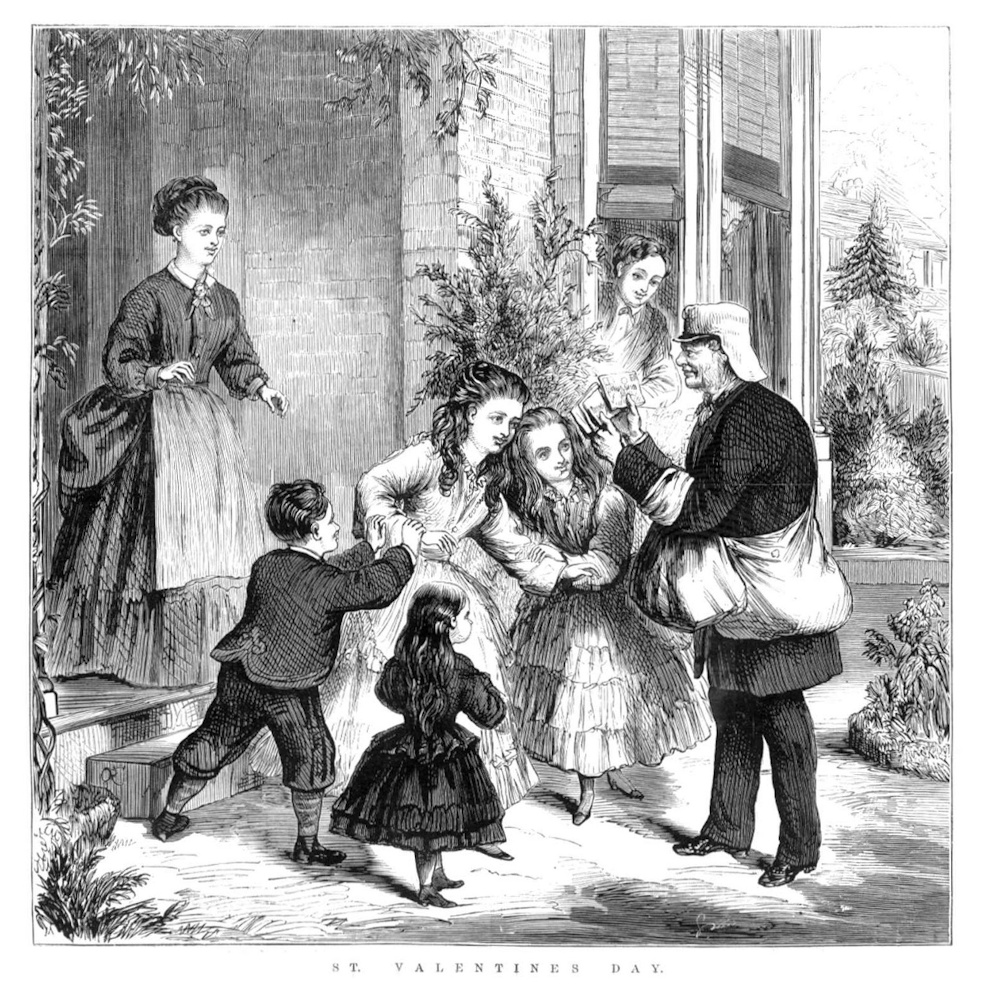
St. Valentines Day.
St. Valentines Day.
The custom of celebrating St. Valentine’s Day has been more or less observed in England and Scotland from time immemorial, and young Victoria has followed with native ardor in the footsteps of the old country.

The feast of St. Valentine in the old days conferred upon young persons the privilege of selecting their lovers and mistresses by a sort of “lot” or “chance.” An equal number of bachelors and maids met together, and each, writing their true or feigned name upon separate pieces of paper, which were then rolled up and drawn for by lots, the maids taking the men’s billets and the men the maids; so that each of the young men lighted upon a girl that he called his valentine, and each of the girls upon a young man whom she called hers.

The Valentine of the present day has culminated in the sending of anonymous love-letters, pictures, photographs, expensive caskets, &c. (with a sincere or satirical intention, as the case may be), on the 14th February.

Look up the street. There’s a man overburdened with a heavy sack on his shoulders, trudging along from house to house, now and again depositing his heavy burden on the footpath. It’s only the postman, and the day is the feast of St. Valentine.

Rat-tat! Down comes a dapper housemaid; white cap, white apron. “For you, Miss,” says Postman. Look at her face as it reddens like the sunny side of a peach, when she takes the letter. There! she runs up stairs to her little room, slams the door, sits on her bed, tears open the letter. What is it? Only a couple of silver hearts frizzling with an arrow stuck in as a skewer, and lots of naked Cupids looking on, laughing and chubby.

Rat-tat. Servant. One, two, three, four letters; one “On her Majesty’s service.” Paterfamilias, materfamilias, and family at breakfast. Look at sweet Adeline, how gingerly she opens a fretted lace-work, containing every insignia of the altar hymeneal, and how she peeps in, and, reading the mottoes, the blood rushes to her fair face. Mark paterfamilias! See, he frowns, tucks “Her Majesty’s Service” letter in his pocket, and resumes his morning’s Age. What, why is this? Have not his employes sent him a pretty severe dose for reducing their screw, and don’t they hold the mirror up to him that he can observe and feel his own meanness!

Rat-tat, rat-tat; significant of a social method of expressing grudge, mischief, love, hatred, insinuations, and ofttimes plain honest truth on this feast of St. Valentine.


Source:
The Illustrated Australian News for Home Readers (Melbourne, Vic.), 24 February 1875, p. 26 (10th page of this issue)

Also published in:
The Illustrated Adelaide News (Adelaide, SA), 1 February 1876, p. 6 [illustration on p. 4]

Editor’s notes:
The illustration, titled “St. Valentines Day”, appeared on page 17 (1st page of that issue) of the same issue of The Illustrated Australian News for Home Readers. It shows a family eagerly greeting a postman, waiting to get their Valentine’s Day cards.

Acknowledgments are due to the State Library of Victoria for their digitization work (see the Trove entry for the illustration accompanying this article).

&c. = &c. = an alternative form of “etc.”; an abbreviation of “et cetera” (also spelt “etcetera”), a Latin term (“et” meaning “and”, “cetera” meaning “the rest”) which is translated as “and the rest (of such things)”, used in English to mean “and other similar things”, “other unspecified things of the same class”, or “and so forth”

Age = The Age (Melbourne, Vic.) newspaper

employe = (commonly spelt “employé”): an archaic form of “employee”; plural: employés (employees)

ofttimes = (also spelt: oft-times) oftentimes, often, on many occasions; frequently, repeatedly (from Old English, “oft” meaning “often” or “frequently”)

screw = in a work context, a reference to wages or salary

[Editor: The original text has been separated into paragraphs.]

Filed Under: articles Tagged With: 500x500, grammar - Oxford commas, graphics added, SourceSLV, SourceTrove, Valentine's Day, year1875

Reader Interactions

Leave a Reply Cancel reply

Your email address will not be published. Required fields are marked *

Primary Sidebar

The Institute of Australian Culture
Heritage, history, and heroes. Writers, workers, and wages. Literature, legends, and larrikins. Stories, songs, and sages.

Search this site

Featured books

The Man from Snowy River and Other Verses, by Banjo Paterson A Book for Kids, by C. J. Dennis  The Bulletin Reciter: A Collection of Verses for Recitation from The Bulletin The Songs of a Sentimental Bloke, by C. J. Dennis The Complete Inner History of the Kelly Gang and Their Pursuers, by J. J. Kenneally The Foundations of Culture in Australia, by P. R. Stephensen The Australian Crisis, by C. H. Kirmess Such Is Life, by Joseph Furphy
More books (full text)

Featured lists

Timeline of Australian history and culture
Significant events and commemorative dates
A list of significant Australiana
Australian slang
Books (full text)
Australian explorers
Australian literature
Recommended poetry
Poetry and songs, 1786-1900
Poetry and songs, 1901-1954
Rock music and pop music (videos)
Folk music and bush music (videos)
Early music (videos)
Topics
Links

Featured posts

Advance Australia Fair: How the song became the Australian national anthem
Brian Cadd [music videos and biography]
Ned Kelly: Australian bushranger
Under the Southern Cross I Stand [the Australian cricket team’s victory song]

Some Australian authors

Barcroft Boake
E. J. Brady
John Le Gay Brereton
C. J. Dennis
Mary Hannay Foott
Joseph Furphy
Mary Gilmore
Charles Harpur
Grant Hervey
Lucy Everett Homfray
Rex Ingamells
Henry Kendall
“Kookaburra”
Henry Lawson
Jack Moses
“Dryblower” Murphy
John Shaw Neilson
John O’Brien (Patrick Joseph Hartigan)
“Banjo” Paterson
Marie E. J. Pitt
A. G. Stephens
P. R. Stephensen
Agnes L. Storrie (Agnes L. Kettlewell)

Recent Posts

  • Danger in the Bush [poem re drop bears, 17 September 1891]
  • Armistice [by G. J. Hill, 1 December 1930]
  • Gold in possession: Beaufort man involved: City court convicts: Notice of appeal [20 April 1916]
  • Died on Active Service / Heroes of the Empire [Australian military personnel (WW1, WW2), 24 April 1943]
  • Flooded house on Villiers Street, Grafton (NSW) [postcard, circa 1950]

Top Posts & Pages

  • Australian slang, words, and phrases
  • The Man from Snowy River [poem by Banjo Paterson]
  • Epistolary eloquence [letter from a convict, 7 November 1828]
  • The Man from Ironbark [poem by Banjo Paterson]
  • Rommel’s comments on Australian soldiers [1941-1942]

Archives

Categories

Posts of note

The Bastard from the Bush [poem, circa 1900]
A Book for Kids [by C. J. Dennis, 1921]
Click Go the Shears [traditional Australian song, 1890s]
Core of My Heart [“My Country”, poem by Dorothea Mackellar, 24 October 1908]
Freedom on the Wallaby [poem by Henry Lawson, 16 May 1891]
The Man from Ironbark [poem by Banjo Paterson]
Nationality [poem by Mary Gilmore, 12 May 1942]
The Newcastle song [music video, sung by Bob Hudson]
No Foe Shall Gather Our Harvest [poem by Mary Gilmore, 29 June 1940]
Our pipes [short story by Henry Lawson]
Rommel’s comments on Australian soldiers [1941-1942]
Shooting the moon [short story by Henry Lawson]

Recent Comments

  • Nick on The Sliprails and the Spur [poem by Henry Lawson]
  • Hayden Giles on Drop Bears
  • chris levett on [A Very Charming Gentleman] [poem by C. J. Dennis]
  • WARREN DAVID SHARDLOW on Flash Jack from Gundagai [song, 1905]
  • Brendan Kelly on Unfurl the Flag [song, 16 December 1882]

For Australia

Copyright © 2026 · Log in