• Skip to primary navigation
  • Skip to main content
  • Skip to primary sidebar

The Institute of Australian Culture

Heritage, history, and heroes; literature, legends, and larrikins

  • Home
  • Articles
  • Biographies
  • Books
  • Ephemera
  • Poetry & songs
    • Recommended poetry
    • Poetry and songs, 1786-1900
    • Poetry and songs, 1901-1954
    • Rock music and pop music [videos]
    • Early music [videos]
  • Slang
  • Timeline
    • Timeline of Australian history and culture
    • Calendar of Australian history and culture
    • Significant events and commemorative dates
  • Topics

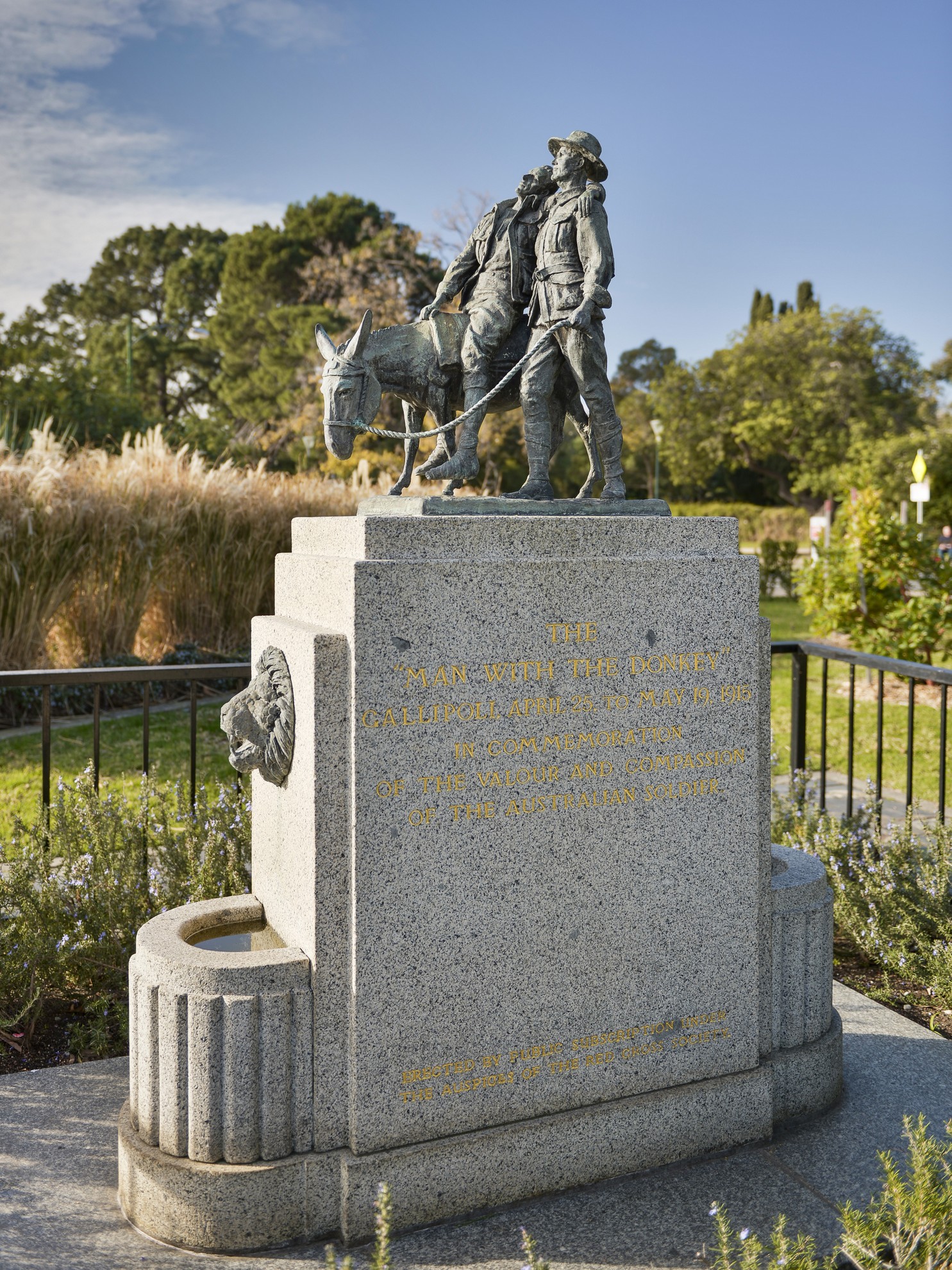
The Man with the Donkey [postcard, monument of Simpson and his donkey, circa 1940s-1950s]

21 December 2023 · Leave a Comment

[Editor: This postcard, which incorporates a photo of a monument of Simpson and his donkey, is undated; however, it is believed to have been published in the 1940s or 1950s.]

Postcard, with a photograph of a monument of Simpson and his donkey (circa 1940s to 1950s).
Front of postcard


Australian postcard, circa 1940s to 1950s.
Reverse of postcard

[Front of postcard]

“The Man with the Donkey.”
Domain.
Melbourne, Vic.

102
Copyright.

[Description: Photograph of a monument of Simpson and his donkey.]

[Reverse of postcard]

Post Card

Correspondence       Address only

Kodak Kodak Kodak Kodak

[Handwritten text, in italics]

My Dear Sweetie.

I hope that old cough has gone & that you are nice & sparky.

How do you like your new school teacher? I hope that she is very nice.

Uncle’s old wonky leg isn’t sparking very well.

Our new wireless is goodoh, how is yours? What do you think of Dad & Dave?

Love to Mum & Merle & lots to you.

xxxxx Auntie Nell

x x


Source:
Original document

Editor’s notes:
Dimensions (approximate): 89 mm. (width), 138 mm. (height).

See also: The Man with the Donkey [postcard, monument of Simpson and his donkey, circa 1950-1954]

This monument, of Simpson and his donkey, is located at the Shrine of Remembrance in Melbourne (Victoria).
See: 1) “Man with the Donkey”, Shrine of Remembrance (State Government of Victoria)
2) “Man with the Donkey (aka Private John Simpson and his Little Donkey) 1935”, City of Melbourne [includes a good quality colour photo of the monument]
3) “Simpson and his Donkey Melbourne”, Virtual War Memorial Australia
Dad & Dave = Dad and Dave from Snake Gully (commonly known as Dad and Dave), an Australian radio drama series based on the characters and stories from the book On Our Selection (1899) written by Steele Rudd
See: “Dad and Dave from Snake Gully”, Wikipedia

goodoh = (also spelt: good-o, good-oh) good; alright; I agree, yes (“goodoh” is usually used to express admiration, approval, pleasure, or satisfaction; also used to signify agreement)
See: “phrase “good-oh””, IAC list (on Trove)

Simpson and his donkey = John Simpson Kirkpatrick (1892-1915), soldier, known to history as “the man with the donkey” due to his heroic work at Gallipoli of bringing wounded solders back for medical care, often under fire, using a donkey to transport them; he was born in Shields (County Durham, England) in 1892, came to Australia in 1910, joined the Australian Imperial Force in Perth (WA) in 1914 (using the name John Simpson), was assigned to the Australian Army Medical Corps, and was killed in Monash Valley (Gallipoli Peninsula, Turkey) in 1915 (during the First World War, 1914-1918)
See: 1) G. P. Walsh, “John Simpson Kirkpatrick (1892–1915)”, Australian Dictionary of Biography
2) “John Simpson Kirkpatrick”, Wikipedia
3) “KIRKPATRICK, John Simpson”, Virtual War Memorial Australia

sparky = animated, cheery, entertaining, full of spark, lively, spirited, vivacious

x = a symbol for a kiss (depending on the circumstances, it may indicate a loving kiss, a familial kiss, or a friendly kiss)

wonky = askew, lopsided, misaligned, not level, not straight, off-centre; groggy, rickety, shaky, unsteady; feeble, not quite right, unreliable; not working very well, liable to develop a fault or cease functioning

[Editor: For ease of reading, the original text has been separated into paragraphs, and punctuation has been inserted as deemed appropriate.]

Filed Under: ephemera, postcards Tagged With: 500x500, Auntie Nell (connected correspondence), correspondence (original), Editor's notes additional (new), ESU funding, HTML tables (side) div style, IAC Ephemera Collection, military-related ephemera, photographs, postcards, SourceIACLibrary, YearDecade1940s

Reader Interactions

Leave a Reply Cancel reply

Your email address will not be published. Required fields are marked *

Primary Sidebar

The Institute of Australian Culture
Heritage, history, and heroes. Writers, workers, and wages. Literature, legends, and larrikins. Stories, songs, and sages.

Search this site

Featured books

The Man from Snowy River and Other Verses, by Banjo Paterson A Book for Kids, by C. J. Dennis  The Bulletin Reciter: A Collection of Verses for Recitation from The Bulletin The Songs of a Sentimental Bloke, by C. J. Dennis The Complete Inner History of the Kelly Gang and Their Pursuers, by J. J. Kenneally The Foundations of Culture in Australia, by P. R. Stephensen The Australian Crisis, by C. H. Kirmess Such Is Life, by Joseph Furphy
More books (full text)

Featured lists

Timeline of Australian history and culture
Significant events and commemorative dates
A list of significant Australiana
Australian slang
Books (full text)
Australian explorers
Australian literature
Recommended poetry
Poetry and songs, 1786-1900
Poetry and songs, 1901-1954
Rock music and pop music (videos)
Folk music and bush music (videos)
Early music (videos)
Topics
Links

Featured posts

Advance Australia Fair: How the song became the Australian national anthem
Brian Cadd [music videos and biography]
Ned Kelly: Australian bushranger
Under the Southern Cross I Stand [the Australian cricket team’s victory song]

Some Australian authors

Barcroft Boake
E. J. Brady
John Le Gay Brereton
C. J. Dennis
Mary Hannay Foott
Joseph Furphy
Mary Gilmore
Charles Harpur
Grant Hervey
Lucy Everett Homfray
Rex Ingamells
Henry Kendall
“Kookaburra”
Henry Lawson
Jack Moses
“Dryblower” Murphy
John Shaw Neilson
John O’Brien (Patrick Joseph Hartigan)
“Banjo” Paterson
Marie E. J. Pitt
A. G. Stephens
P. R. Stephensen
Agnes L. Storrie (Agnes L. Kettlewell)

Recent Posts

  • Danger in the Bush [poem re drop bears, 17 September 1891]
  • Armistice [by G. J. Hill, 1 December 1930]
  • Gold in possession: Beaufort man involved: City court convicts: Notice of appeal [20 April 1916]
  • Died on Active Service / Heroes of the Empire [Australian military personnel (WW1, WW2), 24 April 1943]
  • Flooded house on Villiers Street, Grafton (NSW) [postcard, circa 1950]

Top Posts & Pages

  • Australian slang, words, and phrases
  • The Man from Snowy River [poem by Banjo Paterson]
  • The Man from Ironbark [poem by Banjo Paterson]
  • Rommel’s comments on Australian soldiers [1941-1942]
  • The Aboriginal Mother [poem by E. H. D. (Eliza Hamilton Dunlop), 13 December 1838]

Archives

Categories

Posts of note

The Bastard from the Bush [poem, circa 1900]
A Book for Kids [by C. J. Dennis, 1921]
Click Go the Shears [traditional Australian song, 1890s]
Core of My Heart [“My Country”, poem by Dorothea Mackellar, 24 October 1908]
Freedom on the Wallaby [poem by Henry Lawson, 16 May 1891]
The Man from Ironbark [poem by Banjo Paterson]
Nationality [poem by Mary Gilmore, 12 May 1942]
The Newcastle song [music video, sung by Bob Hudson]
No Foe Shall Gather Our Harvest [poem by Mary Gilmore, 29 June 1940]
Our pipes [short story by Henry Lawson]
Rommel’s comments on Australian soldiers [1941-1942]
Shooting the moon [short story by Henry Lawson]

Recent Comments

  • Nick on The Sliprails and the Spur [poem by Henry Lawson]
  • Hayden Giles on Drop Bears
  • chris levett on [A Very Charming Gentleman] [poem by C. J. Dennis]
  • WARREN DAVID SHARDLOW on Flash Jack from Gundagai [song, 1905]
  • Brendan Kelly on Unfurl the Flag [song, 16 December 1882]

For Australia

Copyright © 2026 · Log in