• Skip to primary navigation
  • Skip to main content
  • Skip to primary sidebar

The Institute of Australian Culture

Heritage, history, and heroes; literature, legends, and larrikins

  • Home
  • Articles
  • Biographies
  • Books
  • Ephemera
  • Poetry & songs
    • Recommended poetry
    • Poetry and songs, 1786-1900
    • Poetry and songs, 1901-1954
    • Rock music and pop music [videos]
    • Early music [videos]
  • Slang
  • Timeline
    • Timeline of Australian history and culture
    • Calendar of Australian history and culture
    • Significant events and commemorative dates
  • Topics

“Loving Hearts” [postcard, WW1 era (1914-1918)]

20 April 2023 · Leave a Comment

[Editor: This postcard, which incorporates a picture of a Rising Sun symbol, as well as a poem, is undated; however, it is believed to be from the era of the First World War (1914-1918).]
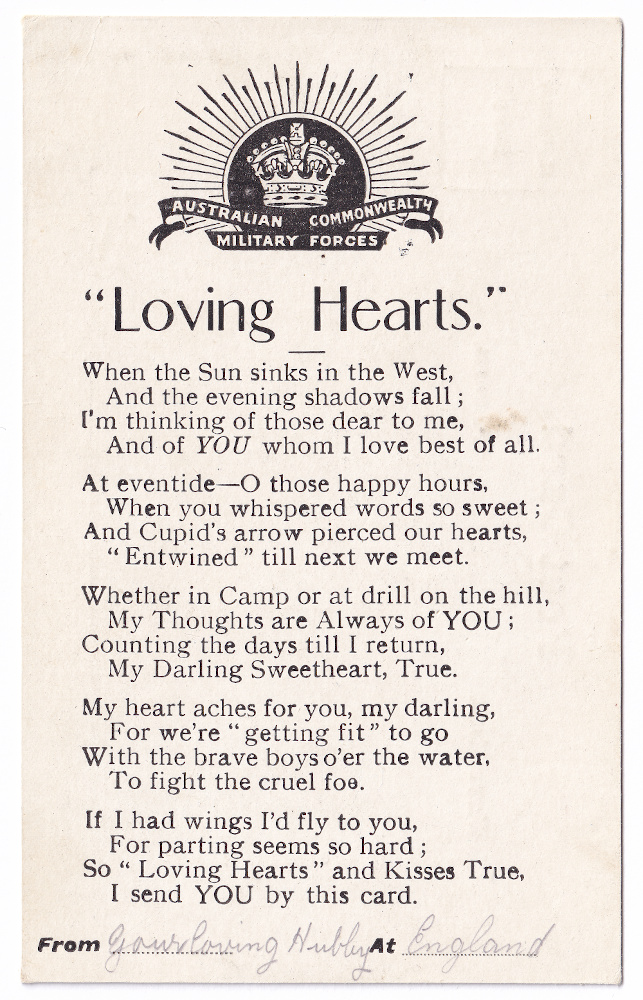
Postcard, with a picture of a Rising Sun symbol, from the First World War (1914-1918)
Front of postcard


A postcard from the era of the First World War (1914-1918)
Reverse of postcard

[Front of postcard]

“LovingHearts.”

When the Sun sinks in the West,
And the evening shadows fall;
I’m thinking of those dear to me,
And of YOU whom I love best of all.

At eventide — O those happy hours,
When you whispered words so sweet;
And Cupid’s arrow pierced our hearts,
“Entwined” till next we meet.

Whether in Camp or at drill on the hill,
My Thoughts are Always of YOU;
Counting the days till I return,
My Darling Sweetheart, True.

My heart aches for you, my darling,
For we’re “getting fit” to go
With the brave boys o’er the water,
To fight the cruel foe.

If I had wings I’d fly to you,
For parting seems so hard;
So “Loving Hearts” and kisses True,
I send YOU by this card.

From … Your loving Hubby At … England

[Handwritten text, in italics]

[Description: A Rising Sun with Crown symbol, with the text “Australian Commonwealth Military Forces” inside a scroll, accompanied by a poem.]

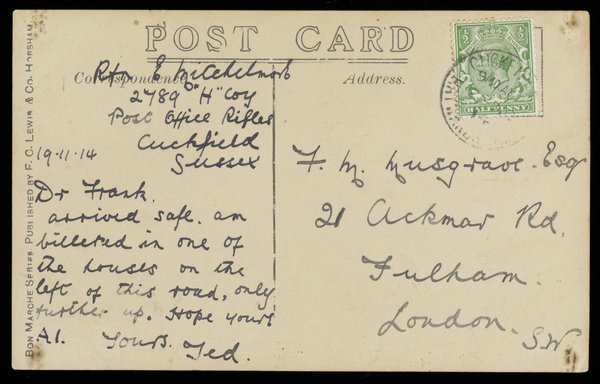
[Reverse of postcard]

Post Card.

Write Here.
Address.

Half-penny Stamp.

[No identifying information about the manufacturer was included on the postcard.]


Source:
Original document

Editor’s notes:
Dimensions (approximate): 140 mm. (width), 87 mm. (height).

It is likely that this postcard was sent from an Australian soldier in England to his wife in Australia during the First World War (1914-1918) or shortly thereafter; it appears that it was sent inside of an envelope, as there is no address given and there are no postal markings on the postcard.

Although the postcard does not include any identifying information about the manufacturer, it is reasonably assumed that it was made in England; this assumption is based upon the reference to England on the front of the postcard, as well as on the reference on the reverse of the postcard to a half-penny postage stamp. Australian postcards of the First World War era required one penny postage stamps, whereas British postcards of that era could be sent with a half-penny postage stamp.
See: “First World War Postcard” (Date: 2014; Accession Number: 2014-0084/01), The Postal Museum (London, England) [an example of a British postcard, with a half-penny postage stamp, dated 19 November 1914 on the reverse side]
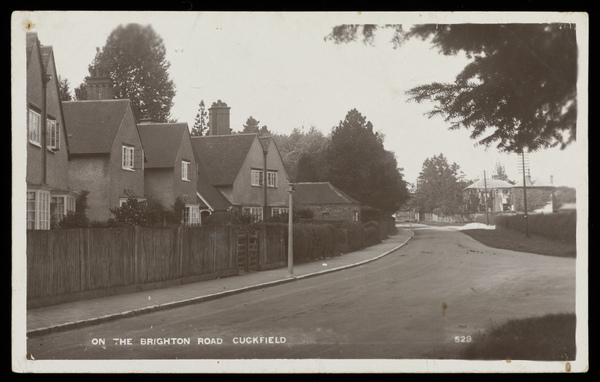
hubby = a diminutive form of “husband”

Filed Under: ephemera, postcards Tagged With: 500x500, correspondence (original), correspondence WW1 era (original), ESU funding, HTML tables (side) div style, IAC Ephemera Collection, military ephemera, postcards, postcards WW1, Rising Sun badge (Australian Army), soldiers' letters WW1 era, SourceIACLibrary, YearEraWW1 (1914-1918)

Reader Interactions

Leave a Reply Cancel reply

Your email address will not be published. Required fields are marked *

Primary Sidebar

The Institute of Australian Culture
Heritage, history, and heroes. Writers, workers, and wages. Literature, legends, and larrikins. Stories, songs, and sages.

Search this site

Featured books

The Man from Snowy River and Other Verses, by Banjo Paterson A Book for Kids, by C. J. Dennis  The Bulletin Reciter: A Collection of Verses for Recitation from The Bulletin The Songs of a Sentimental Bloke, by C. J. Dennis The Complete Inner History of the Kelly Gang and Their Pursuers, by J. J. Kenneally The Foundations of Culture in Australia, by P. R. Stephensen The Australian Crisis, by C. H. Kirmess Such Is Life, by Joseph Furphy
More books (full text)

Featured lists

Timeline of Australian history and culture
Significant events and commemorative dates
A list of significant Australiana
Australian slang
Books (full text)
Australian explorers
Australian literature
Recommended poetry
Poetry and songs, 1786-1900
Poetry and songs, 1901-1954
Rock music and pop music (videos)
Folk music and bush music (videos)
Early music (videos)
Topics
Links

Featured posts

Advance Australia Fair: How the song became the Australian national anthem
Brian Cadd [music videos and biography]
Ned Kelly: Australian bushranger
Under the Southern Cross I Stand [the Australian cricket team’s victory song]

Some Australian authors

Barcroft Boake
E. J. Brady
John Le Gay Brereton
C. J. Dennis
Mary Hannay Foott
Joseph Furphy
Mary Gilmore
Charles Harpur
Grant Hervey
Lucy Everett Homfray
Rex Ingamells
Henry Kendall
“Kookaburra”
Henry Lawson
Jack Moses
“Dryblower” Murphy
John Shaw Neilson
John O’Brien (Patrick Joseph Hartigan)
“Banjo” Paterson
Marie E. J. Pitt
A. G. Stephens
P. R. Stephensen
Agnes L. Storrie (Agnes L. Kettlewell)

Recent Posts

  • Danger in the Bush [poem re drop bears, 17 September 1891]
  • Armistice [by G. J. Hill, 1 December 1930]
  • Gold in possession: Beaufort man involved: City court convicts: Notice of appeal [20 April 1916]
  • Died on Active Service / Heroes of the Empire [Australian military personnel (WW1, WW2), 24 April 1943]
  • Flooded house on Villiers Street, Grafton (NSW) [postcard, circa 1950]

Top Posts & Pages

  • The Man from Snowy River [poem by Banjo Paterson]
  • Australian slang, words, and phrases
  • The Man from Ironbark [poem by Banjo Paterson]
  • Gallery of Gold Licenses (Victoria)
  • Epistolary eloquence [letter from a convict, 7 November 1828]

Archives

Categories

Posts of note

The Bastard from the Bush [poem, circa 1900]
A Book for Kids [by C. J. Dennis, 1921]
Click Go the Shears [traditional Australian song, 1890s]
Core of My Heart [“My Country”, poem by Dorothea Mackellar, 24 October 1908]
Freedom on the Wallaby [poem by Henry Lawson, 16 May 1891]
The Man from Ironbark [poem by Banjo Paterson]
Nationality [poem by Mary Gilmore, 12 May 1942]
The Newcastle song [music video, sung by Bob Hudson]
No Foe Shall Gather Our Harvest [poem by Mary Gilmore, 29 June 1940]
Our pipes [short story by Henry Lawson]
Rommel’s comments on Australian soldiers [1941-1942]
Shooting the moon [short story by Henry Lawson]

Recent Comments

  • DESMOND Fell on The tragic note in Australian literature [book review, 15 June 1946]
  • David Spackman on Chapter 1 [The Complete Inner History of the Kelly Gang and Their Pursuers, by J. J. Kenneally]
  • Greg Kilmartin on Aussie Verse and Verse-Writers: 1. Banjo Paterson [16 February 1918]
  • Nick on The Sliprails and the Spur [poem by Henry Lawson]
  • Hayden Giles on Drop Bears

For Australia

Copyright © 2026 · Log in