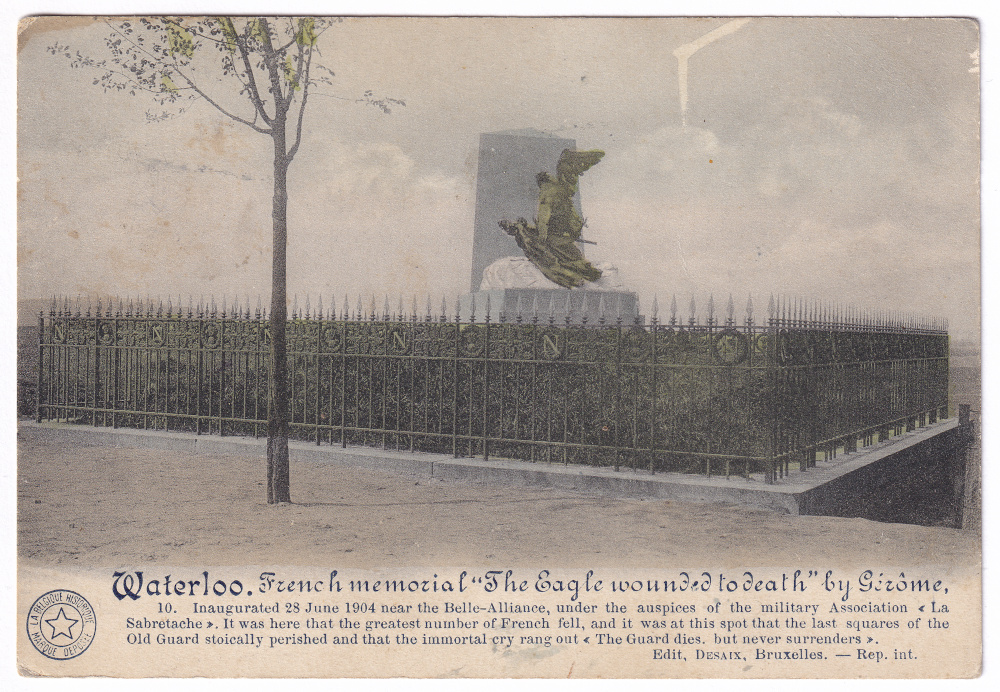
[Editor: This postcard, which incorporates a photograph of a memorial statue known as the “Monument of the Wounded Eagle” (located near Waterloo, in Belgium), is dated 25 December 1918 (just after the end of hostilities of the First World War, 1914-1918, following the signing of the armistice on 11 November 1918).]

[Front of postcard]
Waterloo. French Memorial “The Eagle wounded to death” by Gérôme,
10. Inaugurated 28 June 1904 near the Belle-Alliance, under the auspices of the military Association “La Sabretache”. It was here that the greatest number of French fell, and it was at this spot that the last squares of the Old Guard stoically perished and the immortal cry rang out “The Guard dies, but never surrenders”.
[Manufacturer’s information:]
Edit, Desaix, Bruxelles. — Rep. int.
La Belgique Historique Marque Deposee
[Description: A photograph of a memorial statue known as the “Monument of the Wounded Eagle” (located near Waterloo, in Belgium).]
[Reverse of postcard]
[Handwritten text, in italics]
On Active Service
Waterloo
Belgium
25.12.18
Dear Ma
Just a line to say am quite well & doing a bit of sight-seeing at present.
Not a bad way to spend Xmas.
Will write later.
Yours affect
Will
[Addressed to:]
Mrs G. Wale
25 Hunter St
Richmond
Victoria
Australia
Source:
Original document
Editor’s notes:
Dimensions (approximate): 130 mm. (width), 89 mm. (height).
affect = an abbreviation of “affectionately”
Belgique Historique Marque Deposee = (Belgique Historique Marque Déposée) Historical Belgium Registered Trademark
Belle-Alliance = La Belle Alliance, an inn in Belgium; it is in the municipality of Lasne (Belgium), and is located north-west of the village of Plancenoit, south-west of the town of Lasne, and south of the farm of La Haye Sainte (near Waterloo)
See: “La Belle Alliance”, Wikipedia
Bruxelles = (French) Brussels (the capital city of Belgium; a region of Belgium, also known as the Brussels-Capital Region)
eagle = the symbol of several nations and states (e.g. the empires of France, Germany, Russia, and the Holy Roman Empire, and the countries of Mexico, Panama, and the USA)
The Eagle wounded to death = a memorial statue, known as the “Monument of the Wounded Eagle” (“L’Aigle blessé” in French), which commemorates the last stand of the grenadiers of the Imperial Guard at the Battle of Waterloo (1815); the statue was created by Jean-Léon Gérôme (1824-1904) and Henri Paul Nénot (1853-1934); it is in the municipality of Lasne (Belgium), and is located north-west of the village of Plancenoit, south-west of the town of Lasne, and south of the farm of La Haye Sainte (near Waterloo); according to author Mohammad Abdur Rahman Khan, “It was at this spot that the French army suffered most heavily and the Old Guard in the last phases of the battle, shattered by the bayonet attacks of the British Guards and surprised by the Prussian under Blucher, refused to surrender, and forming into squares perished to a man, shouting “La Guarde meurt, mais ne se rend pas.” The Old Guard dies but does not Surrender!”
See: 1) “Monument of the Wounded Eagle”, Waterloo Tourisme
2) “List of Waterloo Battlefield locations”, Wikipedia [see photo: “Monument to the last fighters of the Grand Army (The Wounded Eagle)”]
3) “L’Aigle blessé” [The Wounded Eagle], Wikipedia [in French]
4) “Jean-Léon Gérôme”, Wikipedia
5) “Henri Paul Nénot”, Wikipedia
6) “La Haye Sainte”, Wikipedia
7) Mohd. [Mohammad] Abdur Rahman Khan, My Life and Experiences, Hyderabad-Deccan (India): Krishnavas International, 1951, pp. 73-74
8) “Imperial Guard (Napoleon I)”, Wikipedia [see section re the quote “The Guard dies but does not surrender!”]

Will = a diminutive form of “William”; there are several diminutive forms of William: Bill, Billie, Billy, Will, Willie, Wills, Willy, (Scottish) Wullie
Xmas = an abbreviation of “Christmas”
[Editor: For ease of reading, the original text has been separated into paragraphs, and punctuation has been inserted as deemed appropriate.]
Dear Ed.
Within the hand-written text which you have transcribed, I see:
“… & doing a bit OF SIGHT-SEEING at present …”
I also notice that the top centre of that side of the postcard, has a hand-stamped inked imprint, which to my eyes looks like a “lion rampant” in its centre; and around the outside, I think that I discern:
“PANORAMA DE LA BATAILLE de (??) WATERLOO”
The inked stamp to the right is too faint for me to try to read it.
Thanks as always.
Hi Raymond,
Thanks so much for your help!
I looked at that wording several times, trying to figure it out.
Was it “night” or “right”? And, if so, what was the other word?
And then you came to the rescue.
Thanks again.
Regards, Ed
As luck would have it on Friday we were at the RAF Club in London with some chums. One, a Press Photographer for many years in Reading (UK), produced several postcards of Waterloo, of which this was one. All but one had serrated edges suggesting they had been in a booklet of cards to be torn out for use. None of the cards had been used. They range across; an image of The Duke of Wellington, the building were he based himself, images of the battlefield from the air and the Lion memorial from afar. Difficult to date pre or post WWI. I was given them as I am one of a number of guides at the Duke of Wellington’s Country House, Stratfield Saye, and give talks about the Life of the Duke of Wellington and of course his battles as well as his amours and funeral.