
Cartes de visite (visiting cards, with photographs attached) were a phenomenon in the Western world (including Australia), beginning in the 1850s. They were similar to modern business cards, except that they were commonly used for social purposes. They became quite fashionable, with some later cards featuring fancy designs and illustrations; as a social item, they even became sought after by contemporary collectors. The size of the average carte de visite (abbreviated as CdV or CDV) was approximately 6.3 cm. by 10.5 cm. (4.1 inches by 2.5 inches).[1]
Cabinet cards were arguably a logical extension of the cartes de visite. They were roughly about two and a half times larger than cartes de visite, and were suitable for mounting on a cabinet or a side table, or could be placed in any other prominent space in one’s home (most likely propped up on a wooden stand, or placed in a photograph frame). The size of the average cabinet card was approximately 10.9 cm. by 16.5 cm. (4.3 inches by 6.5 inches). As with the cartes de visite, the size of the photographs glued onto the cards varied, but they normally took up the majority of the space available. The larger area of the medium enabled (and encouraged) a higher quality photograph to be used. Cabinet cards began to be used for portraits in Australia in 1866, and were fashionable from the mid-1860s to the 1890s; although, they still had a significant advertising presence right up until 1909, along with a slight peak in 1914-1916 (during the First World War, 1914-1918). Their popularity was eclipsed with the advent of snapshots and the rise of the photographic postcard.[2]
Cabinet cards were, in effect, larger sized versions of cartes de visite. However, their cardboard mounts were significantly thicker than the small photographic visiting cards. As with cartes de visite, their mounts were commonly a cream colour, although darker colours were used for various cabinet card mounts in the 1880s and 1890s (using colours such as black, dark brown, burgundy, and green).[3]
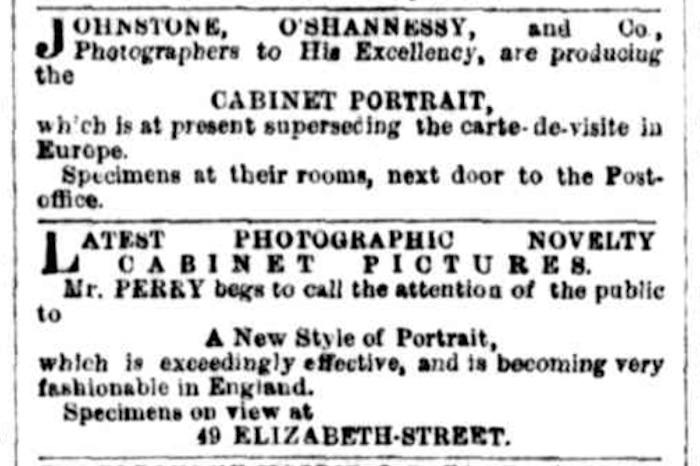
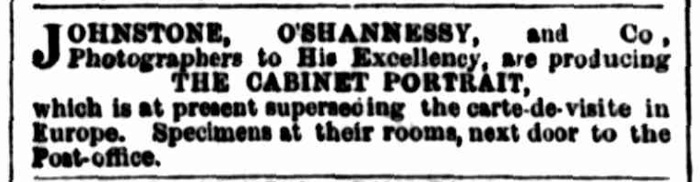
To gain an idea of the usage of cabinet cards in Australia, a search was conducted of the historical newspapers on the National Library of Australia’s Trove site for how often they were mentioned in advertisements, as an indicator of their popularity. A search for “cabinet cards” produced very few results; further investigation revealed that most photographic advertisements referred to them as “cabinet portraits” or simply “cabinets” (they were also called “cabinet pictures”). A search for the phrase “cabinet portraits”, in the “Advertising” category returned the following results:
1860-1869 (2k)
1870-1879 (1k)
1880-1889 (2k)
1890-1899 (6k)
1900-1909 (3k)
1910-1919 (1k)
1920-1929 (269)
1930-1939 (37)
It can be seen that, judging by the number of advertisements for their sale, the popularity of cabinet cards, or cabinet portraits, in Australia was nowhere near that of the cartes de visite. Considering that they were much more expensive, even with the compensation that they were bigger and of better quality, their comparatively lower level of popularity due to their cost should be no surprise.[4]
The era of cartes de visite and cabinet cards was a golden age for Australian portrait photography. As a result of the tens of thousands of photographs taken, we have been given a lasting legacy of untold numbers of portraits of colonial and Federation-era Australians. Thousands of these photographs still survive to this day, not only giving us an insight into the fashions and cultural experiences of early Australians, but also providing us with tangible links to our past.
See also:
Cartes de visite
Photography prices (regarding cartes de visite and cabinet cards)
References:
[1] “Cartes de visite”, The Institute of Australian Culture, 12 May 2023
[2] “Cabinet card”, City Gallery [1866; 1924; snapshot]
Colin Harding, “How to spot a cabinet card (1866–c.1914)”, The National Science and Media Museum (Bradford, UK), 5 September 2013 [says cabinet cards appeared in the 1860s; photographic postcard]
Samuel Thomas, “What is a Carte de visite? (1850 – 1910)”, 13 July 2020 [says cabinet cards appeared in the early 1870s]
See also:
“Cabinet card”, Wikipedia
Notes:
Measurements taken of cabinet cards in the IAC collection give the following results:
Width 10.9 cm = 4.2913385827 inches (4 and 19/64 inches)
Height 16.5 cm = 6.4960629921 inches (6 and 1/2 inches)
In contrast to the CDVs, all of the cabinet cards in the IAC collection are very close to each other in size. Measurements were taken in centimetres, and were converted to inches using UnitConverters.net.
[3] “Cabinet card”, City Gallery
Colin Harding, “How to spot a cabinet card (1866–c.1914)”, The National Science and Media Museum (Bradford, UK), 5 September 2013
[4] See: Trove search for “cabinet portraits” in the Advertising category, Trove (National Library of Australia) [results can be sorted by decade, as above, using the “Date range” function]
Trove search for ““cabinet cards”~0” in the Advertising category, Trove (National Library of Australia) [results can be sorted by decade, as above, using the “Date range” function]
Note: In contradistinction to cartes de visite, it is far more problematic to gauge the popularity of “cabinet cards” by using the same methodology as was used for CDVs. Even when using a refined search, the Trove search engine picks up a significant number of extraneous results, where the words “cabinet” and “card” are located adjacent to each other (for example, the Trove search results include advertisements which mention “blotting cases, cabinets, card boxes”, etc.), so therefore the results are not as accurate as may be desired. However, as the term “cabinet portraits” appears to have been the term generally used in photographic advertisements, a search for “cabinet cards” is somewhat superfluous, and the term “cabinet portraits” was used to gauge that format’s popularity (through advertising) instead.
Note: This article was originally part of the “Cartes de visite” article, but has now been separated so as to enable a specific focus on cabinet cards.
Updated 3 December 2023
Leave a Reply